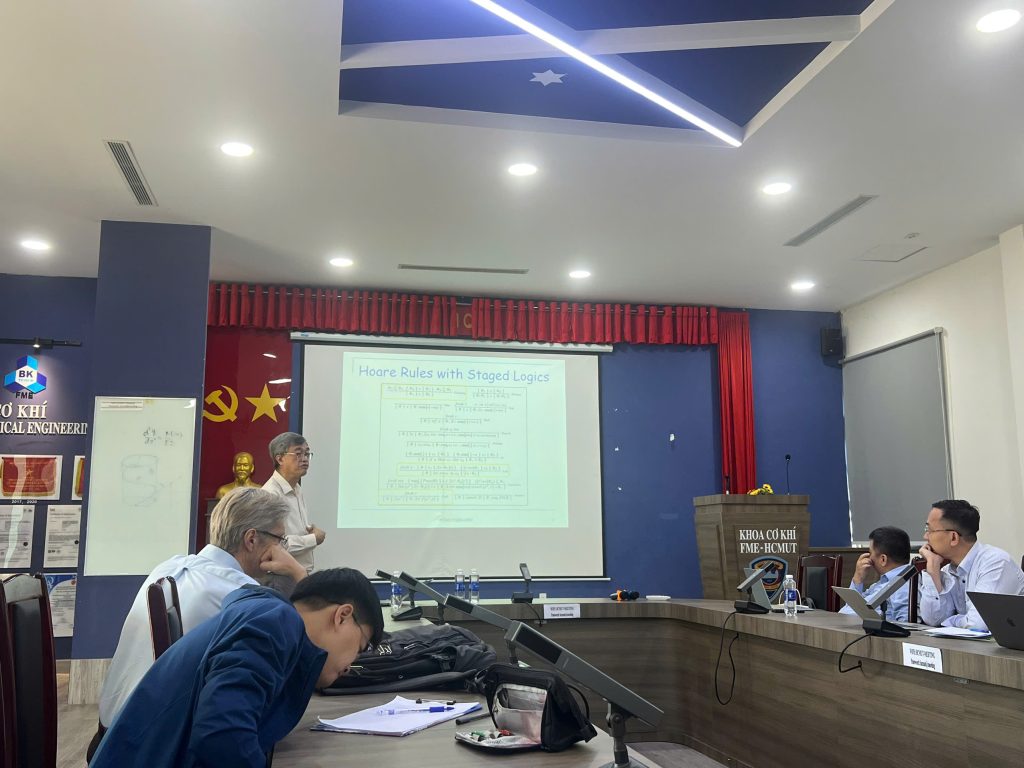
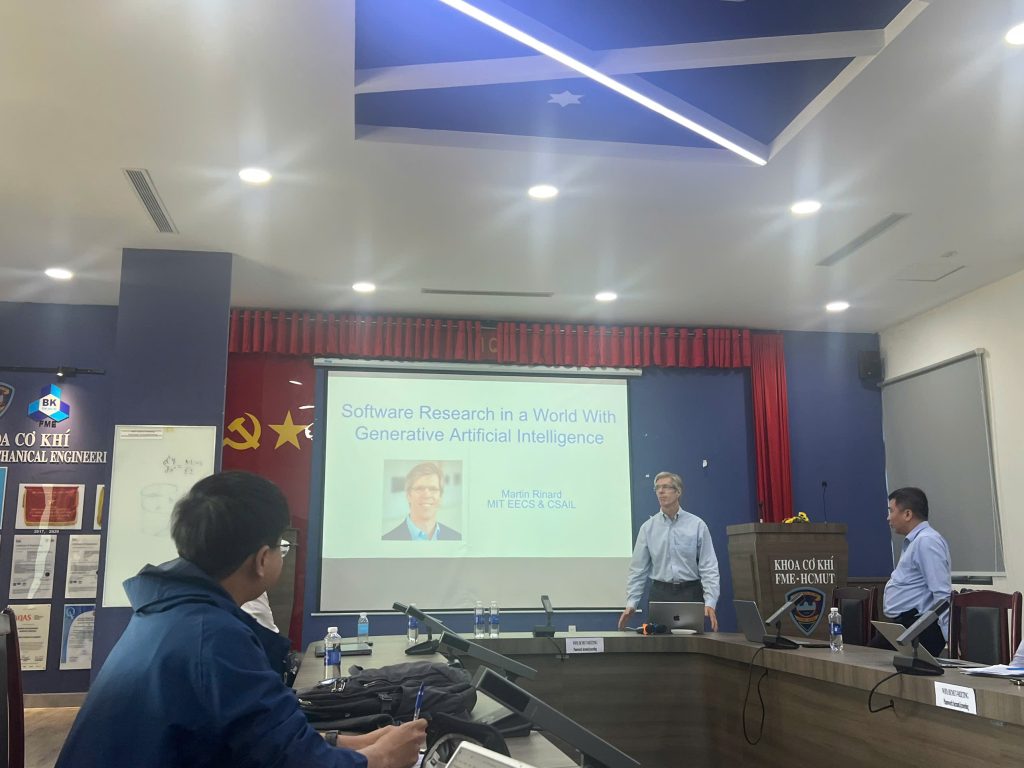
On December 23, HCMUT had the pleasure of welcoming two distinguished visitors for a day that felt less like a routine seminar and more like the start of longer conversations. Prof. Chin Wei-Ngan (National University of Singapore, NUS) delivered “Staged Logic for Verifying Higher-Order Functions,” while Prof. Martin Rinard (Massachusetts Institute of Technology, MIT) presented “Software Research in a World With Generative Artificial Intelligence.” Although the talks came from different traditions—formal reasoning on one side, AI-era software research on the other—they converged on a shared theme: building software we can trust, and building research communities that can work together to get there.
What stood out was not only the content, but also the discussions it sparked. Prof. Chin’s talk brought a sense of structure and clarity: how we can think about correctness in a way that scales with modern programming patterns and encourages disciplined reasoning. Prof. Rinard’s talk brought urgency and realism: software today lives inside sprawling ecosystems, where dependencies, automation, and generative models change both how we build and how things can go wrong. In the room, these perspectives didn’t compete—they complemented each other, and that complementarity created space for questions that felt genuinely collaborative rather than purely technical.
Many of the best moments came from the way both talks nudged the audience toward broader reflections. Instead of asking only “does this technique work?”, the discussion naturally shifted to “what does it enable?”, “what new failure modes appear?”, and “how do we bring these ideas into real workflows?” That framing matters because it invites participation from students and researchers across multiple areas—software engineering, security, systems, and AI—who may not usually share the same seminar room. The result was a more inclusive and forward-looking discussion: people weren’t just consuming ideas; they were imagining what could be built next.
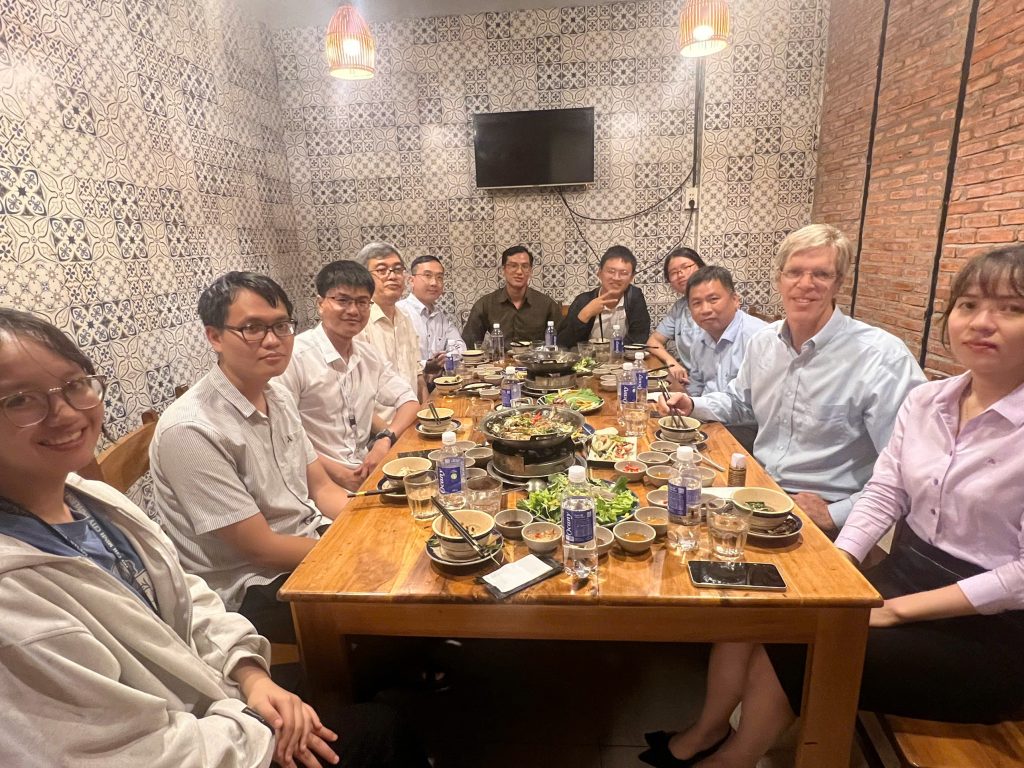
The day also had a warm, community-building rhythm. After the talks, the visitors joined a lunch gathering, followed by a campus tour of HCMUT. Those informal settings often become the most valuable part of an academic visit: they make it easier to exchange research interests, talk about student projects, and find the “small first step” that can grow into meaningful collaboration. Conversations over lunch can turn a one-time talk into follow-up emails, shared reading groups, or even joint supervision and co-authored work.
Looking ahead, the visit suggested several realistic paths for collaboration between HCMUT and international partners. There is clear potential for joint work at the intersection of trustworthy software and generative AI, where strong theoretical foundations and practical engineering constraints must meet. Beyond research papers, there are also collaboration formats that can start immediately: student exchanges, co-advised theses, shared benchmarks and datasets, open-source tooling, and recurring seminars that keep the dialogue alive. Even simply aligning on a set of shared questions can be a powerful outcome, because it creates continuity long after the visitors have flown home.
In the end, Dec 23 at HCMUT felt like more than two talks on a schedule. It felt like a reminder that the future of computing is shaped not only by individual breakthroughs, but by communities that can connect ideas across domains and across institutions. With visitors from NUS and MIT, meaningful discussion in the room, and the kind of informal interactions that build real relationships, the day opened up both inspiration and opportunity—exactly what a good academic visit should do.